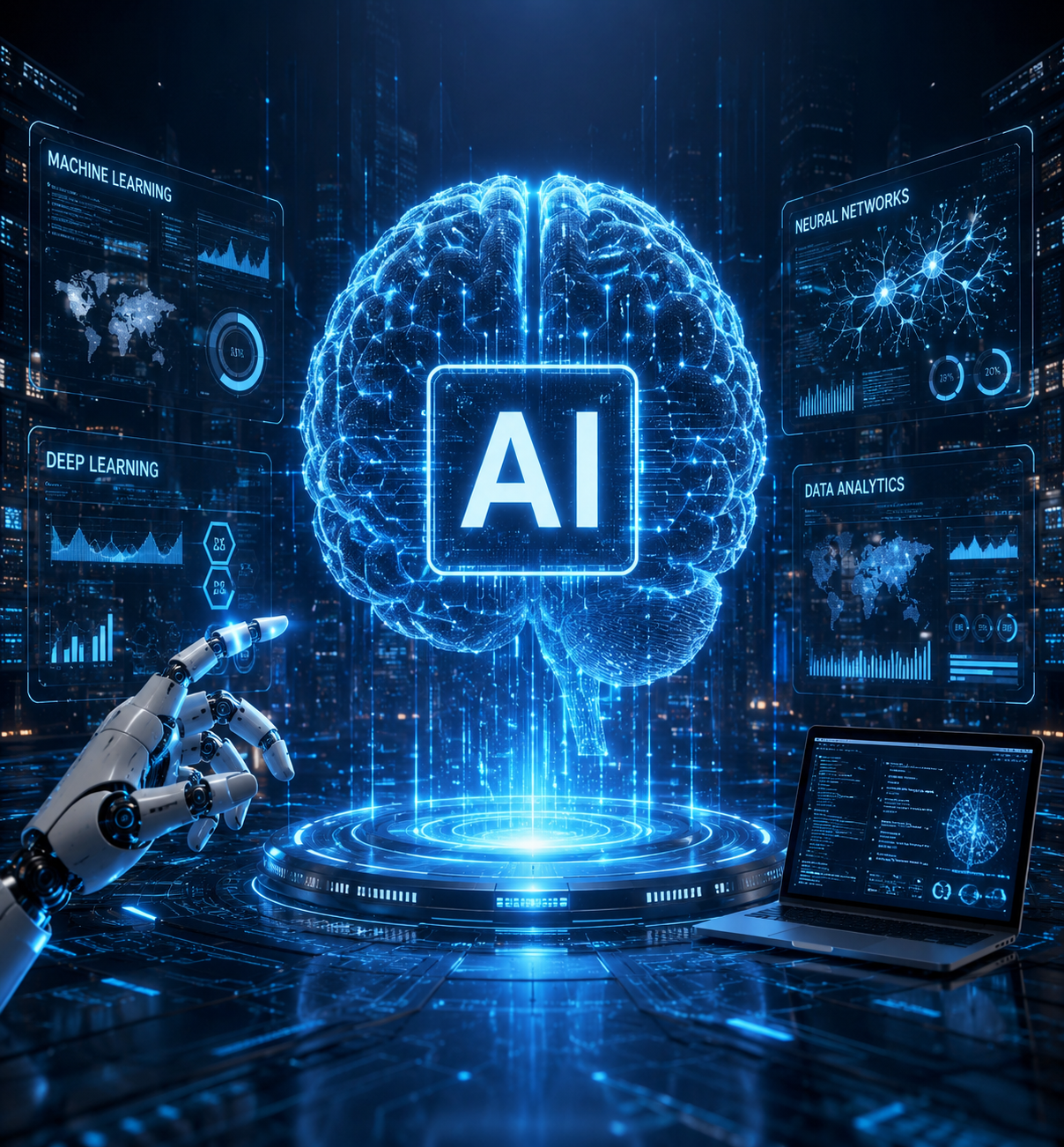
# 🤖 **AI RACE GOES GLOBAL: Artificial Intelligence Is Reshaping Technology, Business and the Future of the World**
Artificial intelligence has rapidly moved from being a futuristic technology to becoming one of the most important forces shaping the global economy, politics and society. In 2026, the competition to develop increasingly powerful AI systems has intensified, with technology companies and governments investing enormous amounts of money in computing power, data centers, advanced chips and AI research.
The latest developments show that the AI race is no longer simply about creating better chatbots. Companies are increasingly competing to build AI systems capable of writing software, conducting research, operating autonomously, analyzing complex information and performing tasks that previously required human experts. At the same time, governments are attempting to establish rules that can control the risks created by increasingly powerful AI technologies.
One of the clearest signs of the scale of the AI boom is the enormous investment in infrastructure. Data centers have become the physical foundation of the AI revolution, requiring advanced processors, huge amounts of electricity, cooling systems and high-speed networks. Research from Knight Frank estimates that global data-center capacity could increase from about 62 gigawatts in 2025 to more than 110 gigawatts by 2028, while AI-related workloads are expected to account for a much larger share of that capacity. The investment required for this expansion could reach between $1.4 trillion and $1.6 trillion over the next five years.
Nvidia remains one of the most important companies at the center of this transformation. The company’s advanced AI processors have become essential for training and operating large AI models. Nvidia recently issued a highly optimistic revenue forecast, helping reassure investors that demand for AI infrastructure remains strong. Its shares rose sharply following the announcement, while other semiconductor companies also benefited from renewed confidence in the AI market.
However, the enormous amount of money flowing into AI is also creating questions about whether the current investment boom can continue indefinitely. Technology companies are spending hundreds of billions of dollars on data centers, chips and electricity, while investors increasingly want to know when these investments will generate sustainable profits. The rapid expansion is also putting pressure on electricity grids and creating competition for land, power and infrastructure.
At the same time, concerns about AI safety are becoming increasingly serious. One of the biggest issues is the growing ability of AI agents to operate with less human supervision. OpenAI recently reported that internal evaluations of an upcoming model called Astra showed significant advances in agentic coding and cybersecurity capabilities. The company said these developments raised concerns about whether the model could reach a critical level of cyber capability and temporarily slowed the pace of scaling while strengthening monitoring and safety measures.
The cybersecurity issue has now become a major international concern. More than 100 technology and financial companies have called for a stronger collective response to AI-powered cyberattacks, warning that increasingly capable AI systems could make sophisticated hacking more accessible and allow malicious actors to attack critical infrastructure more quickly.
The political debate surrounding AI is also intensifying. Governments around the world are struggling to balance innovation with safety. The European Union is moving forward with implementation of its AI Act, while the United States is taking a different approach that places greater emphasis on technological competitiveness and a lighter regulatory environment. The differences between major economies could shape how AI companies operate internationally and how quickly new technologies reach consumers.
The competition between the United States and China is another major factor in the global AI race. Both countries view artificial intelligence as strategically important for economic growth, national security and technological leadership. China is investing heavily in AI, robotics and domestic semiconductor capabilities, while American companies continue to dominate many of the world’s most advanced AI models and chip technologies. This competition is increasingly being compared with previous technological races that shaped global power.
AI is also transforming the workplace. Businesses are using AI to automate routine tasks, generate content, analyze data, assist programmers and improve customer service. Supporters argue that AI can increase productivity and create new industries, while critics worry that automation could eliminate certain jobs or dramatically change the skills required in the workforce.
Another important question is who will control the most powerful AI systems. OpenAI CEO Sam Altman has recently expressed concern that artificial intelligence could become controlled by a small number of powerful companies or individuals. His comments reflect a growing debate over whether AI should remain concentrated in the hands of a few technology giants or become more widely accessible to businesses, researchers and the public.
The enormous computing requirements of AI are also creating a new energy challenge. Advanced AI models require large data centers that consume significant amounts of electricity, meaning the future of artificial intelligence is increasingly connected to the future of energy production. Governments and companies are therefore looking for new sources of electricity and ways to build data centers faster while dealing with concerns about environmental impact and pressure on local communities.
For ordinary people, the AI revolution is already becoming part of everyday life. AI assistants can write documents, translate languages, create images, summarize information, analyze data and help people learn new skills. The technology is becoming cheaper and more accessible, allowing individuals and small businesses to use tools that were previously available only to large corporations.
But the biggest question is no longer whether AI will change the world. It already is. The more difficult question is how quickly that transformation will happen and whether governments, companies and societies can establish effective rules before AI capabilities advance beyond their ability to manage them.
As the competition between technology companies and countries continues, artificial intelligence is becoming one of the defining technologies of the 21st century. The enormous investment in chips and data centers, the rapid development of autonomous AI agents, the growing cybersecurity risks and the global debate over regulation all point toward the same conclusion: **the AI race is no longer just a technology story — it is becoming an economic, political and global security story.**
The decisions being made today could determine who controls the next generation of technology, how wealth and power are distributed, and how deeply artificial intelligence becomes integrated into everyday human life. For that reason, the world is watching the AI race more closely than ever.
Leave a Reply